
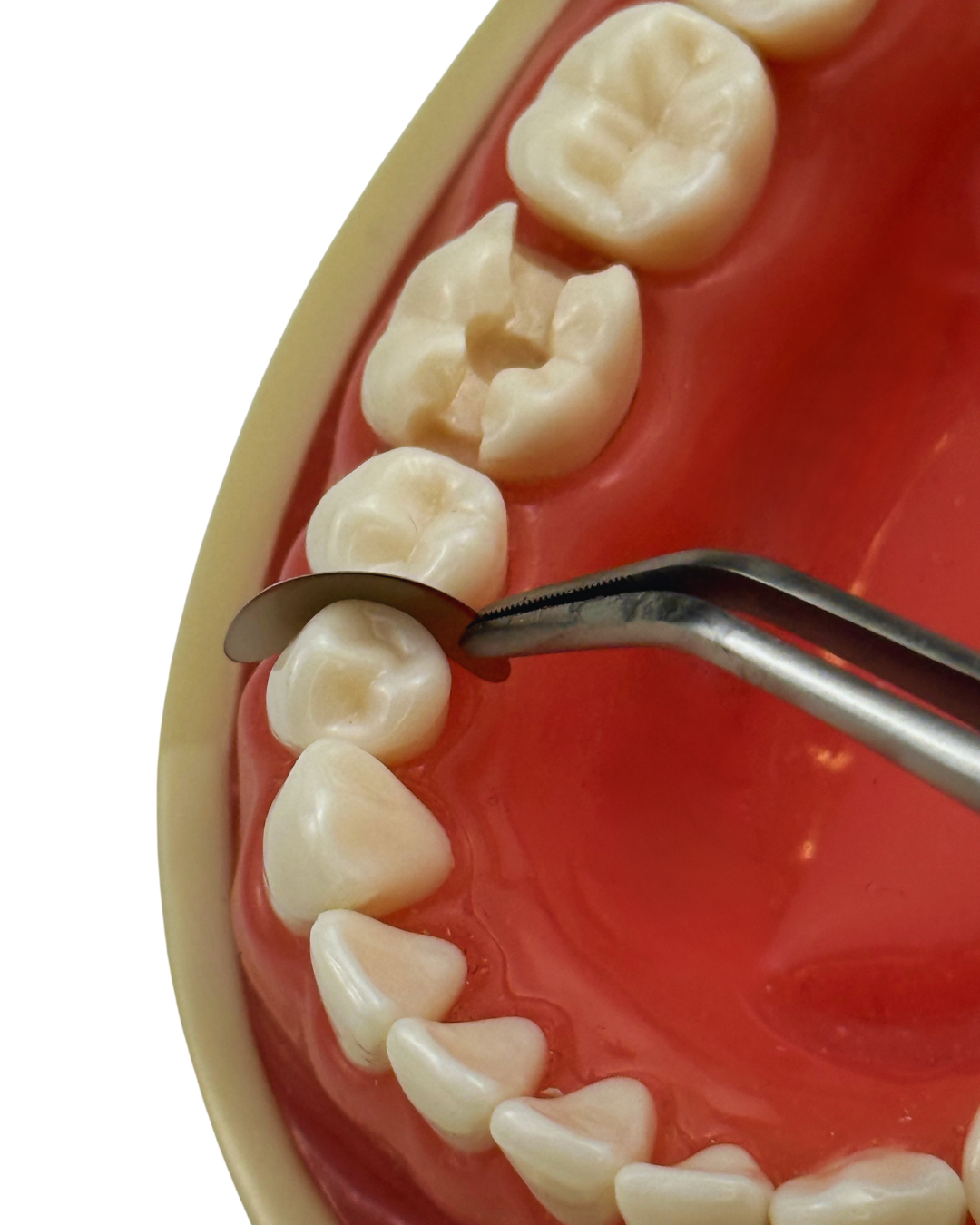
Class II restorations require careful planning along with the optimization of multiple crucial steps; one of which includes matrix and wedge placement. A successful matrix placement is integral to the procedure. Hence, when encountered with unique cases requiring proper proximal contact formation – it is important to choose a suitable matrix. If you are looking to achieve strong and predictable proximal contacts, Tor VM’s B-Series Sectional Contoured Matrices are the perfect fit. They significantly reduce the risk of open restoration margins (which often trap food debris, plaque and bacteria), they are specifically designed to support the natural tooth contour and they accurately replicate the natural tooth anatomy.
Moreover, a significant advantage of using these sectional matrices includes decreased post-operative trimming time. This can be achieved through accommodating a close adaptation to the occlusal and proximal contours of the tooth which allows for an overall tighter matrix conformation. This, in turn, minimizes excess flash which thereby reduces finishing. Some points of attention during placement include the specific part of the matrix which is being directly handled. Bending the middle of the occlusal edge can create a deformation that interferes with proper marginal ridge contour. This is why it is imperative to grasp the matrix band at the corner.
Additionally, make sure the concave edge of the band is the one making contact with the occlusal margin of the tooth. In order to firmly install the matrix, it can be flossed into position and further secured with a wedge. A helpful tip during placement is to keep a finger over the matrix while placing the wedge in order to prevent the band from getting pushed out. The versatility of these incredible devices allows the optimization of adaptation and placement. Particularly, the two levels of rigidity offered enable ready installment (if the hard rigidity is selected) or the ability to contour/adapt the matrix to facilitate proper proximal contact formation (if the soft rigidity is selected). When it comes to the two possible thicknesses – it is apparent that each offers its own advantages; the 0.050 mm thickness is most optimal for large decays in the subgingival area while the 0.035 mm thickness is more suitable for smaller decays. Lastly, the various sizes help match distinct bicuspid and molar anatomy – the smaller size is ideal for narrower proximal areas, the medium size is ideal for routine restorations while the large size works best for wider proximal surfaces. Is it important to note that each package includes 50 pieces of your chosen matrices.
To conclude, the B-Series Sectional Contoured Matrices are great for contouring and restorative procedures. Being so multifaceted is what makes them so particularly useful, and it is imperative that you try them during your next class II restoration.